

Website AI Chatbot Assistant on AWS

Legacy Transfer Solutions required a website-integrated AI chatbot assistant capable of providing secure, intelligent, and context-aware responses to customer queries. The solution needed to use AWS-managed generative AI services, retrieve approved information from internal knowledge sources, and provide a modern customer-facing chat experience on the existing website.

The Challenge

LTS needed to improve website-based customer interaction by introducing an AI assistant that could answer common customer questions in real time while staying within approved domain boundaries. The chatbot needed to integrate with the website, retain conversation context, use internal documents for retrieval, and include filtering mechanisms to prevent irrelevant or unsafe responses.

Key challenges included:
  • Need for a real-time bidirectional chatbot experience embedded in the existing website
  • Requirement to handle session context, message flow, and backend integration securely
  • Need to use AWS Bedrock foundation models for intelligent, context-aware responses
  • Requirement to ground chatbot answers using internal documents, FAQs, and knowledge base content
  • Need to enforce safe and domain-relevant responses using Bedrock Guardrails and filtering controls
  • Requirement to build a responsive frontend chatbot interface aligned with the website user experience
  • Need for logging, tracing, observability, testing, and production deployment readiness

Why Futuralis
& AWS

LTS partnered with Futuralis because of its experience building AWS-native generative AI applications, serverless APIs, Bedrock Agent architectures, secure cloud deployments, and customer-facing digital experiences.
AWS provided the managed services required to deliver the chatbot quickly and securely without requiring LTS to operate custom AI infrastructure. Futuralis used AWS services to combine real-time APIs, Bedrock foundation models, RAG-based knowledge retrieval, guardrails, frontend integration, and operational monitoring into a production-ready chatbot foundation.

Futuralis designed the solution around:
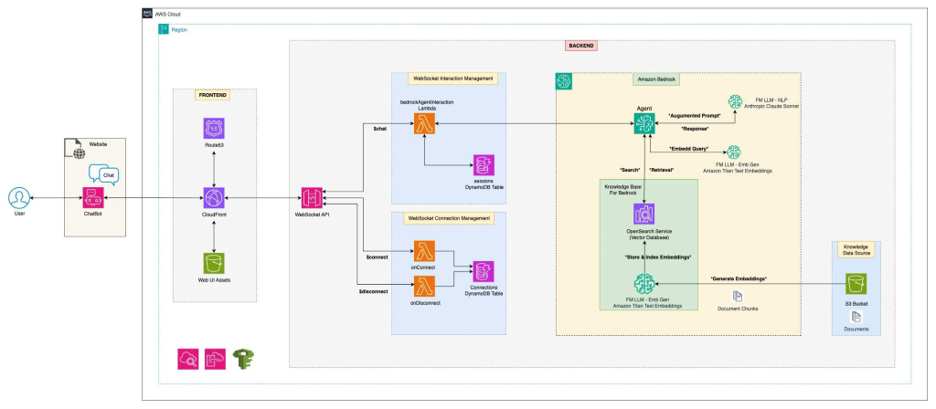
  • Real-time chatbot communication using Amazon API Gateway WebSocket APIs
  • Serverless backend processing using AWS Lambda
  • AI orchestration and response generation using Amazon Bedrock Agents and foundation models
  • Knowledge base document storage using Amazon S3
  • Domain-relevant response control using Bedrock Guardrails and content filtering
  • Global website delivery and routing support using Amazon CloudFront and Amazon Route 53
  • Operational visibility using Amazon CloudWatch and AWS X-Ray

Our Solution

The AWS-centered solution to meet PCI compliance included:

Futuralis designed and implemented a website AI chatbot assistant on AWS using Amazon Bedrock, Bedrock Agents, Bedrock Guardrails, API Gateway WebSocket APIs, AWS Lambda, Amazon S3, Amazon CloudFront, Amazon Route 53, CloudWatch, and X-Ray. The implementation covered discovery, architecture, backend development, frontend integration, testing, deployment, and handover.

Discovery, Planning, and AWS Setup:

  • Conducted discovery sessions to understand chatbot goals, expected user journeys, knowledge base requirements, and deployment dependencies
  • Collected required AWS account access details and permissions for implementation activities
  • Prepared the project plan, milestones, implementation tasks, and production readiness activities

Real-Time API and Serverless Backend:

  • Developed WebSocket APIs to enable real-time bidirectional communication between the chatbot interface and AWS backend
  • Configured Amazon API Gateway to securely handle chat traffic and route messages to backend processing logic
  • Built AWS Lambda functions for request handling, Bedrock integration, session management, and chatbot workflow orchestration
  • Designed API logic to support message flow, context retention, and reliable interaction processing

Bedrock, RAG, and Guardrail Integration:

  • Configured Amazon Bedrock foundation model access for intelligent and context-aware response generation
  • Configured Bedrock Agent orchestration to handle user queries and response workflows
  • Created an Amazon S3-based knowledge base location for chatbot documents such as PDFs and FAQs
  • Enabled Retrieval-Augmented Generation patterns to enhance responses using approved internal knowledge sources
  • Implemented Bedrock Guardrails and filtering controls to restrict responses to safe and domain-relevant topics

Frontend, Observability, Testing, and Go-Live:

  • Designed and developed a modern responsive chatbot interface aligned with the website user experience
  • Integrated the chatbot frontend with WebSocket APIs for end-to-end interaction capability
  • Configured CloudFront and Route 53 to support performance, routing, and availability of the API endpoints
  • Enabled CloudWatch and X-Ray for logging, metrics, monitoring, and tracing across the chatbot workflow
  • Performed unit, integration, guardrail, performance, and production smoke testing before go-live
  • Delivered documentation, administrative guidance, handover support, and final signoff materials

Results & Benefits

Delivered a website-integrated AI chatbot assistant for real-time customer interactions
Enabled context-aware responses using Amazon Bedrock foundation models and agent orchestration. Improved response grounding through RAG-based retrieval from internal documents and FAQs.
Added response safety and domain relevance controls using Bedrock Guardrails
Implemented a serverless backend using API Gateway and AWS Lambda to reduce operational overhead. Created a responsive frontend chat component aligned with the existing website experience.
Improved operational visibility through CloudWatch logging, metrics, and X-Ray tracing
Established a production-ready deployment and handover process with documentation and validation steps. Created a scalable foundation for future chatbot enhancements such as multilingual support, CRM integration, or live-agent escalation.

Customer-facing AI chatbots require strong content boundaries, guardrails, and domain filtering before launch. RAG-based retrieval is most effective when source documents are curated, current, and structured for user questions. WebSocket APIs provide a strong foundation for responsive real-time chatbot experiences. Observability through logs, metrics, and traces is important for debugging AI responses and backend workflows. Serverless architectures accelerate implementation and reduce ongoing operations for early chatbot deployments. Frontend experience, response latency, and guardrail behavior must be tested together to validate production readiness. Clear handover documentation helps internal teams operate and extend the chatbot after go-live.

Ready to discover how Futuralis can elevate your cloud journey?

Get in touch today and let’s explore the full power of AWS together.